The planning problem.
The Capacity × Information study models these two decisions together. It asks how the cost and timing of information affect the capacity decision.
“Before the booking cutoff the planner may also buy timely signals that split the outcomes into observation cells; the reservation must then cover the heaviest cell.”From my research manuscript, 15 October 2026
Methods I compared.
The implementation includes a pairwise mixed-integer formulation, a submodular-cover heuristic, hierarchy dynamic programming, exact rational checks and information-capacity frontiers. The algorithm that works well depends on the size and structure of the instance.
Benchmark results.
The current manuscript records a 13,300-task benchmark and a 1,600-task controlled rerun. Strengthening cuts did not repay their runtime cost. No single algorithm was best across every regime.
Validation so far.
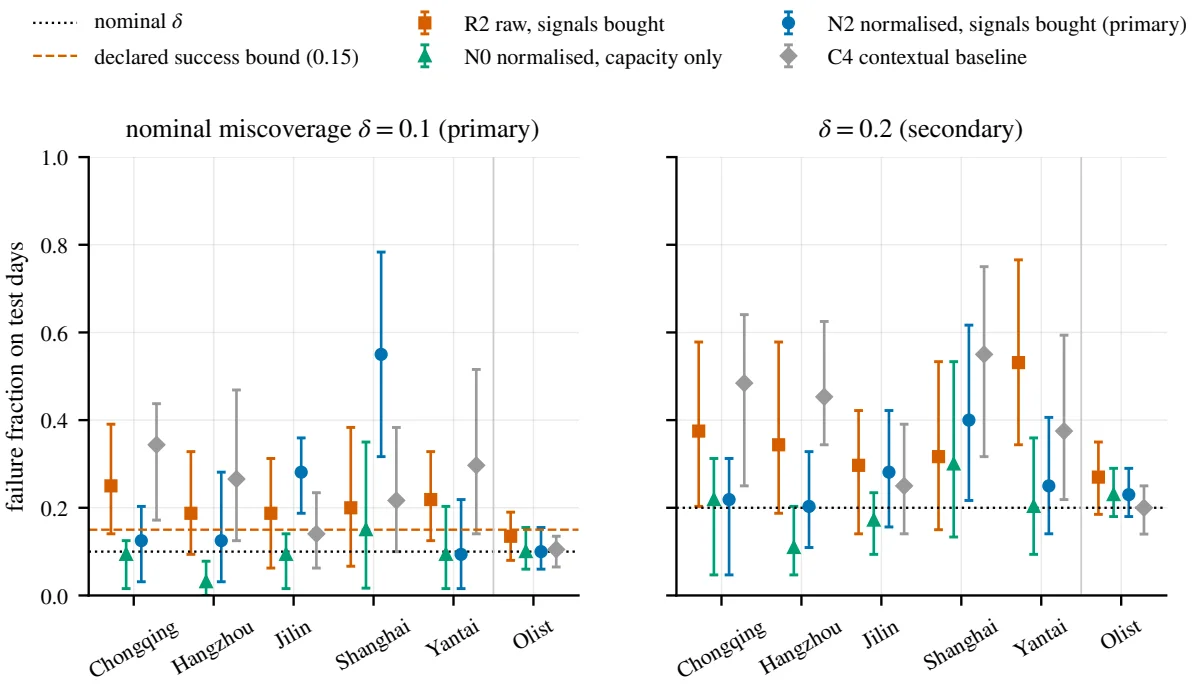
The LaDe pickup validation criterion required four of five cities to pass; three passed. Olist forms a separate validation arm. The manuscript does not establish a general operational benefit for all freight networks.
Cities passed the LaDe pickup criterion.
The declared target was four.
No method performed best across every problem. The city validation also fell short of its target.
Which decision structures carry over from a benchmark to an operating network?
Figure from the October research manuscript.
Research lineage. This chapter describes the newer local October study, not the older submission.