What I’m testing.
The lensing work explores differentiable image formation and Bayesian inference. The narrower allocation study asks a practical question: with a fixed computational budget, which systems should receive a more expensive numerical calculation?
How I set up the comparison.
I separated development, risk calibration and untouched confirmation. The study uses simulated singular isothermal sphere lenses, fixed known nuisance parameters and a single unknown mass parameter. An independent Cartesian quadrature generator helps separate the data generator from the inference approximation.
What happened.
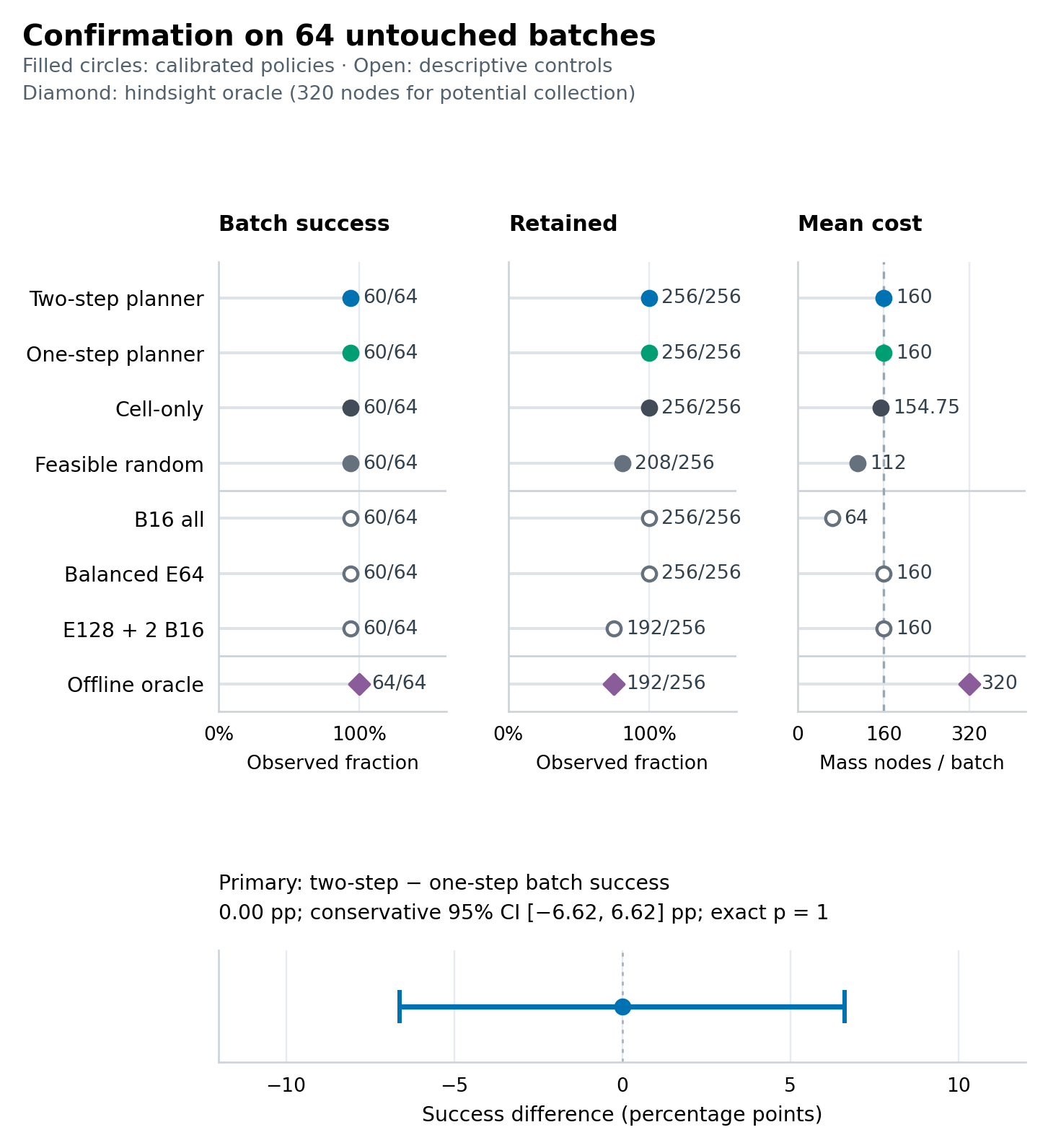
Across 64 confirmation batches, each of four policies succeeded in 60. The coarse B16-all control reached the same count using 64 quadrature nodes per batch, against 160 for the planners. Extra computation did not establish an allocation advantage.
What the result doesn’t tell me.
Equal counts do not prove that the methods are equivalent. This is a conditional study, not a claim about all real lenses. Broader calibration with more unknown parameters remains an open problem.
The cheaper control reached the same observed success count as the more expensive methods.
What changes when the nuisance parameters are no longer known?
Original figure from the conditional study.
Code and evolving research; the portfolio summarizes the local October study.